
Offers starting at NZ$10
NZ$10 is the published minimum to activate these welcome offers. It may differ from the cashier minimum and does not make bonus winnings immediately withdrawable.
 Caxino
100% up to NZ$200 + 100 free spins
10 spins daily for 10 days; spin winnings capped at NZ$1,000.
Offer terms checked 19 October 2026. Confirm the current conditions with the operator.
Minimum depositNZ$10 Wheelz
100% up to NZ$1,000 + 100 free spins
10 spins daily for 10 days; daily spins expire after 24 hours.
Offer terms checked 19 October 2026. Confirm the current conditions with the operator.
Minimum depositNZ$10 Wildz
100% up to NZ$500 + 200 free spins
25 spins daily for 8 days, valued at NZ$0.10 each.
Offer terms checked 19 October 2026. Confirm the current conditions with the operator.
Minimum depositNZ$10 Spinz
100% up to NZ$500 + 200 bonus spins
Balance Booster terms apply 35× wagering to the deposit plus bonus.
Offer terms checked 19 October 2026. Confirm the current conditions with the operator.
Minimum depositNZ$10
Terms and availability may change. No claim or affiliate links are provided, and none of these operators is presented as holding a New Zealand licence.
The lowest amount a casino will accept is only the starting point. A site may take NZ$5 at the cashier yet ask for more to activate a bonus, while a separate withdrawal minimum determines when money can be paid out. Compare the cashier rule, the selected payment method and the cashout terms before treating a headline figure as usable.
New Zealanders aged 18 or over also need to check whether an operator can serve them during the 2026 licensing transition. A low deposit proves nothing about permission, fairness or payout reliability.
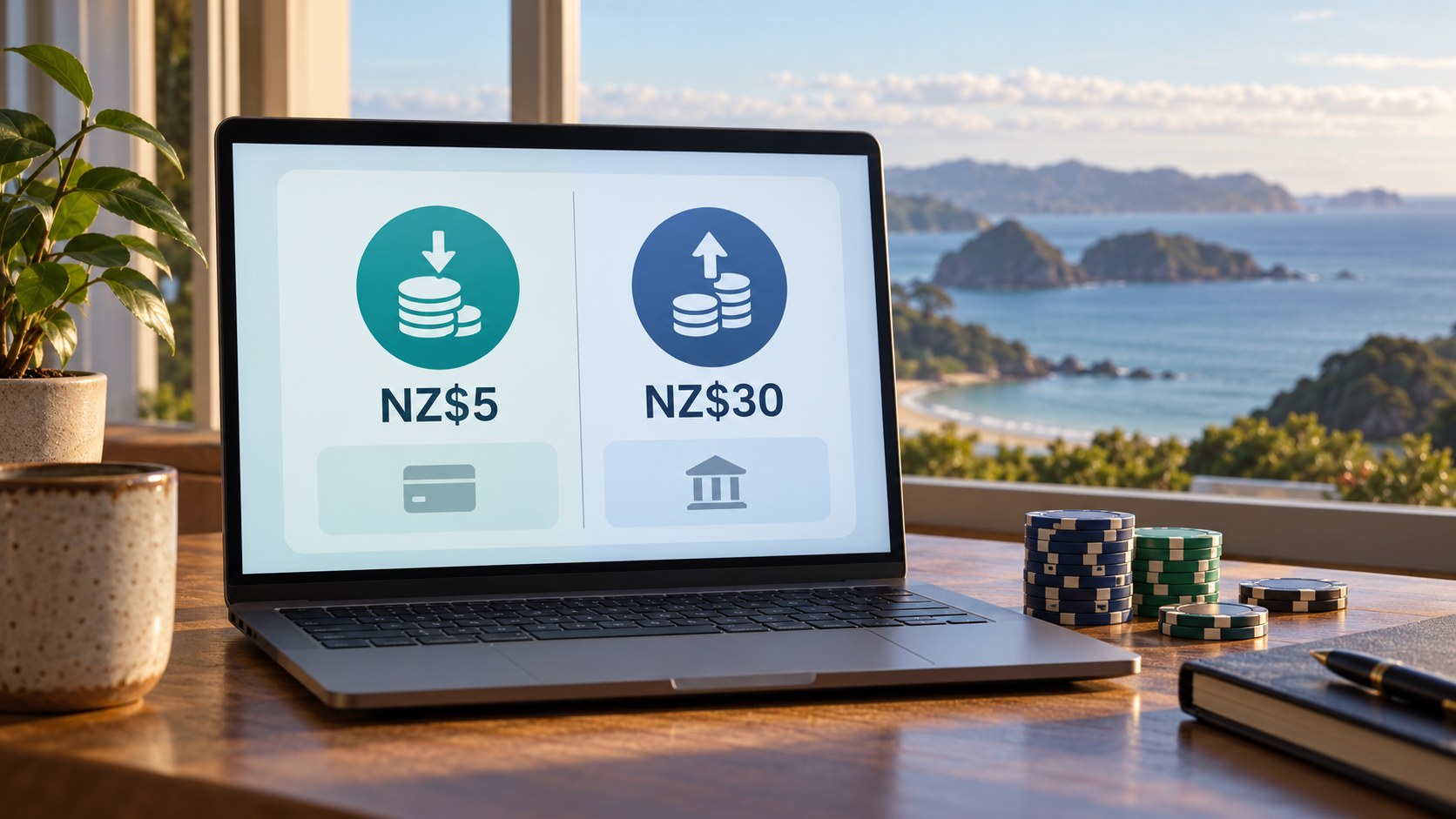
Four amounts that should never be confused
Casino accounts use four distinct minimums. The NZ-dollar figures below show how the rules can differ; none is a verified offer from a New Zealand operator.
| Threshold | What it controls | Illustrative example | Why it matters |
|---|---|---|---|
| Cashier minimum | Smallest payment accepted into the account | NZ$5 | A NZ$3 attempt could be rejected even without claiming a bonus. |
| Bonus qualifying deposit | Payment required to activate a particular promotion | NZ$20 | A NZ$5 deposit might be playable but earn no welcome offer. |
| Minimum bet or spin | Smallest wager accepted by an individual game | NZ$0.20 per spin | The game determines how many wagers a small balance can support. |
| Minimum withdrawal | Smallest amount the casino or payout method will process | NZ$30 | A balance below the threshold might not be withdrawable by that route. |
A minimum deposit sets the floor for one cashier transaction. A personal deposit limit caps how much you can add over a chosen period. Maximum deposits, daily transaction ceilings and withdrawal caps may have their own rules.
A cashier may accept NZ$5 while the selected payout channel requires NZ$30. Do not gamble more merely to close that gap. Ask support about a permitted refund, another cashout route or account closure.
Can you find NZ$1, NZ$5 or NZ$10 minimum deposit casinos?
International comparison lists often sort casinos into $1, $5, $10 and $20 tiers. Those labels are not confirmed NZ-dollar limits or evidence that an operator accepts New Zealand customers. US dollars, pounds, euros and Canadian dollars need to be distinguished from NZD.
| Amount to investigate | Main question | Potential stumbling block |
|---|---|---|
| NZ$1–NZ$2 | Does an accepted local payment method actually allow such a small transaction? | Processing floors, minimum game stakes and fixed fees. |
| NZ$5 | Is this the ordinary cashier floor or only a promotional headline? | Different limits for first and subsequent deposits. |
| NZ$10 | Can the amount be deposited in NZD without conversion or an added fee? | A bonus may require more, and withdrawal conditions still apply. |
| NZ$20 or more | Is the larger amount genuinely required by the chosen payment method or offer? | Depositing extra solely to qualify for a bonus increases exposure to loss. |
A “$5 deposit” in an overseas listing might be US$5. By the time your bank converts it to New Zealand dollars and adds any international transaction charge, the amount debited may be higher. Check the currency, fee and final total on the actual payment screen.
New Zealand's online casino rules in October 2026
The Online Casino Gambling Act 2026 has taken effect, but New Zealand is introducing its online casino licences in stages. The Department of Internal Affairs (DIA) guidance for players says operators serving the market before 1 May 2026 can operate under transitional provisions until 1 December 2026. Advertising online casinos to New Zealanders is currently prohibited.
An auction completed on 12 October 2026 gave 11 entities the right to apply for up to 15 licences. An auction win is not the same as receiving a licence. From 1 December, only eligible applicants whose applications are under consideration may continue under the specified exemption. The DIA expects first licences in early 2027 and plans to publish a register of licensed brands. Check a brand's actual status with the DIA; an offshore licence or auction announcement cannot establish it.
The Online Casino Gambling Regulations 2026 cover age and identity checks, account withdrawals, payment restrictions, deposit and spending controls, and measures to limit harm. Licensed platforms cannot accept credit-linked payments, including credit cards. The framework also requires time, deposit and spending limits and a waiting period before an increase takes effect. Older offshore payment information may describe different rules, especially during the transition.
The UK Gambling Commission (UKGC), Malta Gaming Authority (MGA), New Jersey Division of Gaming Enforcement (NJDGE), Michigan Gaming Control Board (MGCB), and Ontario's AGCO and iGaming Ontario oversee other markets. Their approval does not grant permission in New Zealand. Nor does the UK-only GAMSTOP scheme replace local assistance.
How to check a low-deposit casino before paying
Rule out an unsuitable operator before comparing welcome offers.
- Confirm New Zealand eligibility. Check the DIA's current guidance and, when available, its licensed-operator register. A casino must not be treated as NZ licensed simply because it accepts an NZ address or displays another country's licence.
- Find the actual cashier minimum. Check the specific deposit channel, account currency, transaction fee and whether the first-deposit rule differs from reload deposits.
- Read the withdrawal rules first. Verify minimum cashout, supported payout methods, processing stages, verification requirements, possible fees and what happens to a small residual balance.
- Compare cash play with bonus play. Look for qualifying deposit, wagering multiplier, eligible games, maximum promotional stake, maximum cashout and expiry date. An optional bonus can impose restrictions that cash-only play would not.
- Check the games and controls. Ensure that permitted games have stakes suited to the intended budget, that published game information is understandable, and that session, deposit and time limits are accessible.
- Test transparency without risking funds. Read the terms, identity-check instructions, complaints process and customer-support answers before any deposit. Never rely on an unverified “instant withdrawal” badge or review score.
If licensing, fees or the payout route are unclear, do not make a test deposit. Payment acceptance does not establish that a withdrawal will succeed.
Payment methods: why one cashier can show several minimums
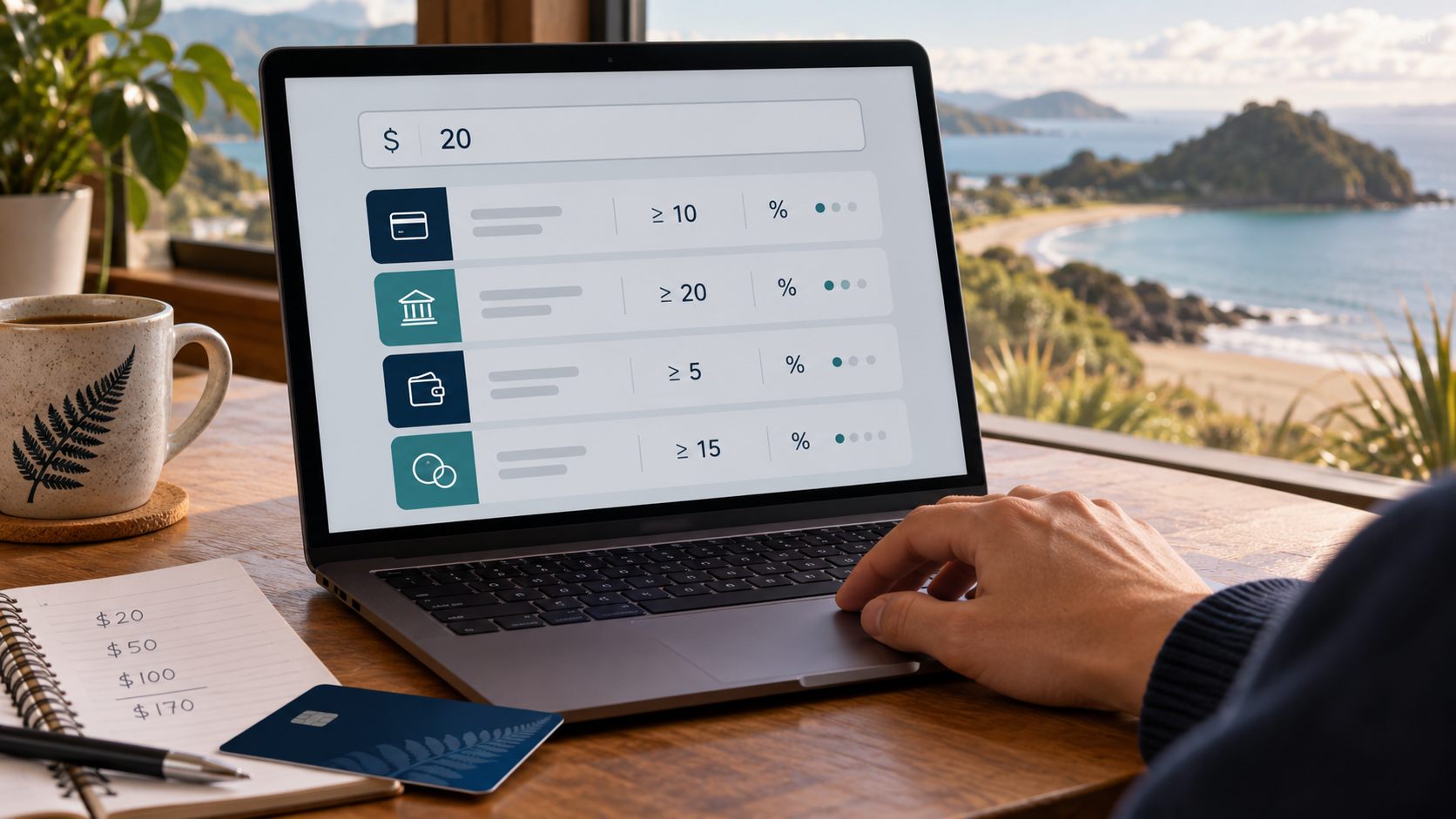
The advertised minimum may not be the minimum for your bank, debit card, e-wallet or prepaid option. Limits vary with the processor, currency, location and operator's regulatory obligations.
| Payment category | Names encountered in casino comparisons | What a New Zealand customer should verify |
|---|---|---|
| Debit cards and mobile wallets | Visa Debit, Mastercard Debit, Apple Pay, Google Pay | Whether the underlying funding source is permitted, NZD billing, international charges and payout compatibility. |
| Bank-based payments | Bank transfer, instant bank transfer, Pay by Bank, Open Banking, Trustly, POLi where offered | Local availability, identity matching, transfer cutoff times and minimum deposit or payout amounts. |
| Digital wallets | PayPal, Skrill, Neteller, MuchBetter | Whether the particular wallet is supported for NZ customers and for withdrawals as well as deposits. |
| Prepaid or mobile billing | Paysafecard, Neosurf, Boku or pay-by-phone arrangements | Fees, funding restrictions and whether a different verified account is required for cashout. |
| Crypto assets | Bitcoin, Ethereum, Litecoin, USDT | Whether the platform and method are permitted, network costs, exchange-rate changes and refund implications; availability must not be assumed. |
A Visa or Mastercard logo does not tell you whether the funding source is debit or credit, a distinction that matters under the New Zealand licensed framework. American Express, Maestro and Visa Electron also appear in international lists without necessarily being available locally. Interac e-Transfer belongs to Canada; ACH, eCheck and Venmo are mainly US arrangements. None should be assumed to work in NZ.
“Instant deposit” describes how quickly money appears in the casino account, not when a cashout reaches the bank. Settlement, fraud screening, identity checks and pending review can delay a withdrawal.
What happens when money moves through the account?
Opening an account is only the beginning. Age and identity checks may come before payment, followed by cashier approval and, if there is a withdrawable balance, a payout request. Know Your Customer (KYC) and anti-money-laundering (AML) checks may require your name, date of birth, address evidence and proof that the payment account is yours. A NZ$5 deposit is not an exemption.
For licensed platforms, the 2026 NZ rules specify one registered deposit method at a time, limits on changing it straight away and a potentially separate registered withdrawal method. An expired card, closed wallet or changed bank account can therefore complicate a cashout. Customer support should explain the authorised process, not request another deposit to “unlock” funds.
Take a hypothetical NZ$10 balance and a NZ$25 cashout minimum. The money is not automatically withdrawable through that route, even when no bets have been made. Ask if the operator allows a refund, account closure or another permitted payment method. Betting more is not a sound workaround.
The 1 December 2026 transition also raises practical questions about accounts held with operators leaving New Zealand: outstanding withdrawals, unused balances and account access. Keep transaction records and support messages; consult the DIA for official consumer guidance.
Do small deposits qualify for welcome bonuses?
Not always. First-deposit matches, welcome packages, reload deals, free spins and cashback offers may demand more than the cashier minimum. A no-deposit bonus does not abolish the minimum for later cash deposits. NZ rules may also restrict or prohibit particular promotions.
A real-money balance and a bonus balance need not have the same cashout rights. Check whether credit is withdrawable and whether an opt-in, promo code, expiry, free-spin stake value, winnings cap, maximum bet, eligible-game rule or maximum cashout applies.
Why a 100% match can require far more than a NZ$10 deposit
Consider a hypothetical 100% match on NZ$10: the player deposits NZ$10 and receives NZ$10 in bonus credit. At 30× the bonus alone, qualifying turnover is NZ$300. At 30× deposit plus bonus, it is NZ$600. These are examples of competing formulas, not offers confirmed for NZ.
At a 20% game-contribution rate, NZ$1,500 in stakes produces only NZ$300 of qualifying turnover. A “wager-free” offer avoids that multiplier but may still restrict expiry, winnings or cashout.
A wagering target measures turnover, not winnings; a NZ$10 balance might run out before it is met. Cashback, lossback and VIP loyalty rewards may impose further conditions. None justifies a larger deposit.
What can you actually play with a small balance?
Match the available cash balance to the minimum stake per game. “Penny slot” is not necessarily a one-cent spin; paylines, coin sizes and settings affect the total. On NZ$5, a NZ$0.20 spin uses 4% of the opening balance and a NZ$1 spin uses 20%. Neither figure predicts how long the money will last.
Slot volatility describes a pattern of results, not protection from losses. Low-volatility slots tend to produce smaller wins more often than high-volatility games in their modelled distributions. Progressive jackpots, Megaways and other high-volatility titles may have unsuitable stake requirements for a small balance. Starburst, Book of Dead, Big Bass Bonanza and Mega Moolah are international game names; their mention does not establish local availability or approval.
Return to Player (RTP) is a long-run theoretical payout measure. With 96% RTP, the corresponding theoretical house edge is 4%; that does not mean a NZ$10 session should end with NZ$9.60. Random number generators (RNGs) and independent testing matter only when the relevant tests and certificates can be checked. RTP alone is not evidence of authorisation.
Roulette, blackjack, baccarat and video poker have different rules, house edges and wager floors. Live dealer blackjack or live roulette can start above the minimum on digital tables. Bingo, keno and scratchcards present other eligibility and risk considerations. Where a free demo exists, it may help with the controls, but it cannot forecast real-money results.
Evolution, Pragmatic Play, NetEnt, Microgaming and Play'n GO supply games. They are not necessarily the company holding the customer's balance or processing cashouts. Those duties fall to the operator under its account terms and applicable rules.
Mobile casinos and the small-balance trap
The same account may work on Android, iPhone, iPad or a desktop browser, through a website or app. App Store and Google Play Store ratings, together with Trustpilot reviews, can flag usability complaints. They cannot verify a licence, a payout policy or the operator's dispute procedure.
On a small phone screen, the deposit button may be obvious while currency conversion and withdrawal rules sit behind expandable text. Open those terms before confirming payment. SSL encryption protects data in transit; it does not certify fair cashouts, independently tested games or permission to operate in NZ.
Repeated promotions and quick-deposit buttons make it easier to spend more than planned. Turn off intrusive notifications and set deposit, loss or session limits. The first small deposit is not a budget cap.
When a minimum deposit is not the right criterion
Five deposits of NZ$5 add up to NZ$25. A low per-transaction floor cannot limit cumulative spend by itself. Gross deposit limits count money paid in; net-deposit measures may offset withdrawals. Record deposits, withdrawals and losses separately instead of relying on the displayed balance.
- Reject an option when its New Zealand regulatory status is unclear or when support cannot explain the deposit and withdrawal rules.
- Do not deposit when a payment method charges a disproportionate fixed fee or converts currencies without clear disclosure.
- Skip an offer when the qualifying deposit or wagering target exceeds the amount you intended to risk.
- Avoid a game when its minimum bet makes each wager a large share of the available balance.
- Choose not to gamble when the money is needed for living costs, when losses feel urgent to recover, or when gambling has stopped being enjoyable.
Licensed-regime protections in New Zealand include deposit, spending and time limits, self-exclusion and other harm-minimisation measures. The DIA's player information points to local help. Gambling Helpline NZ: via gamblinghelpline.co.nz, or text 8006. Safer Gambling Aotearoa offers further resources. Gambling is restricted to adults aged 18 and over.
Common questions about minimum deposit casinos in NZ
Is NZ$5 enough to open a real-money casino account?
Only if the permitted operator and its chosen payment method both accept NZ$5. Registration may be free; the cashier and first-deposit rules still need checking in NZD.
Does a low minimum deposit mean low minimum bets?
No. Slots and table games set their own minimum bets, which can exceed the cashier's smallest accepted deposit.
Can I withdraw my first deposit without playing?
Identity checks and refund terms determine whether unused money can be returned. An immediate cashout may trigger review. Ask for a legitimate refund rather than wagering solely to create turnover.
Do no-deposit bonuses mean the casino has a NZ$0 deposit minimum?
No. “No-deposit” describes the entry requirement for one promotion, not the permanent cashier minimum. Bonus winnings may still carry wagering, identity and payout restrictions.
Are PayPal, POLi or Apple Pay guaranteed to work in New Zealand casinos?
No. International lists may mention PayPal, POLi or Apple Pay without confirming NZD payments or withdrawals for a New Zealand customer. The live NZ cashier terms take precedence.
Can I use a credit card for online casino deposits in New Zealand?
Licensed platforms must not accept payments tied to credit contracts, including credit cards. During the transition, check the operator's status and the rules for debit cards and digital wallets separately.
Is a casino with an MGA or UKGC licence automatically approved in New Zealand?
No. An MGA or UKGC licence is not New Zealand authorisation. As of October 2026, auction winners have only won the right to apply, not a licence.
What happens after 1 December 2026?
Operators lacking the necessary application status must stop offering NZ online casino services from 1 December 2026. Qualifying applicants can continue under the stated exemption while applications are assessed. The DIA expects initial licences in early 2027; consult its latest timetable.
What if a small deposit leaves money below the withdrawal minimum?
Ask support whether a refund, account closure or another approved payout method can release the balance. Keep written records. Further deposits or bigger bets do not resolve the underlying cashout rule.