
Tools for setting gambling limits
| Topic | Current position | Practical effect | Important caveat |
|---|---|---|---|
| Deposit limit | Set a daily, weekly or monthly funding cap | Prevents deposits above chosen budget | Set before play; use operator controls |
| Loss limit | Cap net losses over a selected period | Adds a stop point when losses accumulate | Check how bonuses and pending bets are counted |
| Session reminder | Prompt after a chosen playing duration | Makes time spent visible | A reminder is not a forced stop |
| Cooling-off | Temporarily suspend account access | Useful for a planned break | Confirm duration and account reactivation rules |
| Self-exclusion | Block access for a defined or extended period | Stronger barrier than a reminder | Ask support about exclusions across related brands |
Examples explain how these conditions work. Check the current rules and terms that apply to you.
A deposit limit can stop another top-up on one gambling account. It cannot stop a payment from another account, a cash withdrawal for pokies, or an impulsive visit to a different website. If the goal is to stop gambling rather than manage occasional play, self-exclusion, payment blocks and independent support are stronger starting points than reminders alone.
Choose by the problem you need to prevent: use financial and time limits when gambling remains affordable and controlled; use a time-out when you need an immediate break; use self-exclusion and barriers across several channels when you repeatedly exceed limits, chase losses or find it difficult to stop. No responsible gambling tool makes gambling risk-free.

Which responsible gambling tool should you choose?
| Tool | What it does | What it does not do | Best suited to |
|---|---|---|---|
| Deposit limit | Caps money paid into an account during a specified period. | Does not automatically cap losses or activity on other accounts. | Preventing repeat deposits. |
| Spend or loss limit | Restricts defined expenditure or losses where offered. | Definitions and reset rules can differ. | Keeping track of money at risk. |
| Reality check or session limit | Shows elapsed time, prompts a break or, if enforced, ends play. | A reminder alone does not prevent another session. | Interrupting extended play. |
| Time-out | Temporarily restricts access to a gambling account. | Usually does not block unrelated operators. | Taking a short break. |
| Self-exclusion | Prevents access to specified gambling services or venues for an exclusion period. | Coverage depends on the scheme and jurisdiction. | Stopping gambling rather than setting a budget. |
| Bank block and website blocker | Adds barriers to payments, sites or apps. | May miss misclassified payments, devices or new sites. | Reducing opportunities to bypass an exclusion. |
Set financial limits before depositing
Deposit limits are not the same as loss limits
A deposit limit restricts how much money can enter an online gambling account over a daily, weekly or monthly period. A gross deposit limit counts the amount deposited without subtracting withdrawals. A net deposit limit may account for withdrawals, depending on the operator's definition. The distinction matters: withdrawing money and paying it back in should not be assumed to reset a gross cap.
A loss limit instead measures losses using the operator's stated calculation. A spend limit, wager limit, stake limit or bet-count limit can restrict different aspects of play. A wager cap controls the total amount staked, which may be much greater than the money initially deposited when winnings are staked again. Do not treat these figures as interchangeable.
For a practical check, imagine a weekly deposit cap of NZ$40. If you deposit NZ$40, reach the cap and then withdraw NZ$25, a gross deposit cap still counts NZ$40 already deposited. Whether other limits count that withdrawal differently depends on their rules. Check the operator's definition, the period reset time, whether overlapping daily and weekly caps apply, and whether changes affect linked accounts.
Choose any cap only after accounting for rent, food, transport, utilities, repayments and savings. Money required for essentials is not a gambling budget. A budget calculator or banking transaction history can help establish what is genuinely discretionary. If you are borrowing, missing bills or feeling pressured to win money back, a smaller cap is not an adequate solution: stop and seek support.
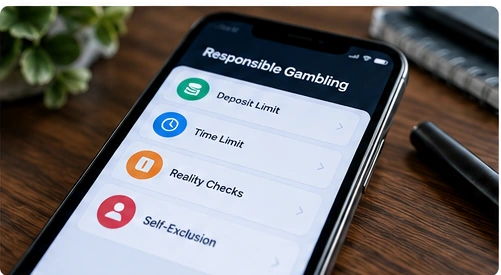
Can you increase a limit immediately?
Not necessarily. Under New Zealand's Online Casino Gambling (Minimum Standards) 2026, the time, deposit and spend limit systems for operators covered by the new framework must impose a wait of at least 24 hours before an increase or removal takes effect. Those standards also require accessible limit settings, free-text limit amounts and enforcement of the lowest applicable limit where periods overlap. Do not assume every offshore site available during the regulatory transition already meets these standards.
If an urge to raise a limit follows a loss, leave the limit unchanged. Repeated increase requests, rapid repeat deposits and chasing losses are warning signs rather than reasons to increase the budget.
Control time: reality checks, breaks and session limits
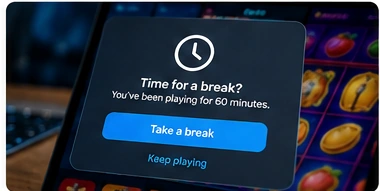
A reality check is a pop-up or periodic reminder showing how long you have been playing, and sometimes your spending or account position. It is useful for noticing a long session but may allow play to continue after dismissal. A session time limit is only a hard stopping point if the platform actually enforces it. A break-in-play or scheduled pause can prevent another round for a period; a time-out may restrict the whole account.
Use an elapsed-time display and alerts as early warnings, not as a substitute for a hard stop. A 30-minute reminder that you dismiss repeatedly is not providing a meaningful barrier. Test what happens when a limit is reached: does play stop, does the account lock, or does another message appear?
New Zealand's rules require casinos to show how long a person has been playing. They prohibit automatic repeat rounds and playing more than one slot game at once, and require at least 2.5 seconds between the start of rounds. An account must also log out after 30 minutes of inactivity. Logging out an inactive account is different from setting a play-time limit: active play may continue unless another limit stops it.
Time-out, self-exclusion and account closure are different decisions
A time-out or cooling-off period can be appropriate when a person recognises a risky pattern early and wants a temporary pause. Self-exclusion is more appropriate when access itself has become the problem: the operator should prevent gambling on the excluded account for the specified period. Closing an account or unsubscribing from marketing is not necessarily the same as formal self-exclusion.
Before requesting exclusion, confirm the length, start date, accounts and brands covered, whether you can still withdraw an existing balance, and how marketing messages are suppressed. Self-exclusion does not reverse past losses. Pending withdrawals and remaining funds should be handled through the operator's lawful account and withdrawal procedures; ask support for written confirmation rather than reopening play to access money.
Under the new New Zealand online casino standards, a covered platform must keep a current self-exclusion register and check it when activating an account and at login. The framework also requires accessible customer support. A person who is blocked from one operator should not assume every other operator, venue, device or payment method is blocked as well.
Multi-venue exclusion for pokies and casinos in Aotearoa
New Zealand already has an established multi-venue exclusion (MVE) process for land-based gambling. People can request exclusion from the gambling areas of specified casinos, pubs, clubs or hotels with pokies. Local support services and MVE coordinators can help arrange exclusion across several venues without having to approach each venue separately. The Department of Internal Affairs outlines the process, and the Problem Gambling Foundation explains how to apply using identification and a photograph.
Venue exclusion orders can last up to two years and cannot simply be cancelled early. TAB betting services have their own exclusion arrangements, so ask which venues and forms of gambling an order covers. MVE for physical venues should not be confused with an online, nationwide casino-account register.
Is there one online self-exclusion register for every New Zealand casino?
Not yet as at October 2026. The Online Casino Gambling Act 2026 requires the Minister to recommend regulations for an online casino self-exclusion register by 1 December 2027. That is a deadline for recommending regulations, not confirmation that a nationwide register already operates. In the meantime, use each available operator's exclusion process and add bank and device controls.
International programmes such as GAMSTOP (Great Britain), BetStop (Australia), Spelpaus (Sweden), Cruks (the Netherlands), OASIS (Germany) and ROFUS (Denmark) have jurisdiction-specific coverage. Signing up to a foreign scheme is not a reliable way to exclude yourself from New Zealand-facing services. Check the programme's eligibility and the actual list of participating operators.
Add barriers beyond the gambling account
Bank and card gambling blocks

A bank's gambling transaction block aims to decline eligible payments that are identified as gambling, often using merchant classification information. It adds friction even when a person has an accessible account elsewhere, but it does not guarantee that every payment route will be recognised.
In Aotearoa, ANZ goMoney lets eligible cardholders turn off online gambling transactions, with a 48-hour wait when turning them back on. Westpac One also offers a gambling restriction on selected cards and warns that merchant miscoding or a separate card can leave gaps. Safer Gambling Aotearoa also lists Kiwibank among banks with gambling blocking options.
Ask your bank whether the block covers debit and credit cards, online and in-person payments, replacement cards, joint accounts, and transactions processed through intermediaries. Check the removal delay. Merchant category codes, alternative payment methods and cash can create exceptions, so combine the bank block with other tools rather than treating it as universal.
Device blocking software and advertising controls
BetBlocker, Gamban and GamBlock are examples of software intended to restrict access to gambling websites and apps. Browser restrictions, network filters and family or parental controls can add another layer, while turning off push notifications, bonus emails and promotional texts reduces prompts to return.
Before relying on blocking software, confirm supported devices, installation permissions, subscription terms, and whether it works across every phone, computer and user profile you use. A blocker may not cover a new site, another device or an alternative connection. It is a barrier, not a guarantee. If you are trying to stop completely, combine it with account exclusion, bank controls and professional support.
What New Zealand's online casino rules require in 2026
The Online Casino Gambling Act 2026 is in force, but New Zealand is moving into a licensed online casino system in stages. According to the Department of Internal Affairs (DIA), pre-existing offshore casino providers may continue operating during the initial transition subject to the law's conditions; the market changes on 1 December 2026, and licences are expected from early 2027. A website having “NZ” in its name does not establish that it holds a New Zealand licence. The regulator plans a public register and registration icon for licensed platforms.
For operators covered by the new framework, the Act, Online Casino Gambling Regulations 2026 and DIA's minimum standards address:
- Age and identity checks: online casino participants must be at least 18; account authentication and customer verification are required.
- Pre-commitment: accessible time, deposit and spend controls, breaks-in-play, time-outs and pop-up alerts.
- Financial protections: restrictions on credit contracts and specified payment methods, with traceable customer transactions and account information.
- Informed decisions: accessible game rules, odds and theoretical return to player (RTP); display of the player's net position during a game.
- Safer game design: rules against autoplay and simultaneous slot sessions, plus constraints on game speed and how rounds begin.
- Operator safeguards: processes for identifying gambling-related harm, managing exclusions, handling complaints, training personnel and keeping auditable records.
Operators may use account activity and risk-detection systems to flag rapid repeat deposits, long sessions, repeated attempts to raise limits or other signs of harm. A meaningful customer interaction may involve a trained person, a restriction or a referral rather than another automated message. These systems can miss risks, and a screening score or financial-risk assessment is not a diagnosis. Effective protection requires operators to identify concerns, act and evaluate whether the intervention worked.
An RTP percentage is a long-run theoretical measure, not the amount a particular person is likely to recover during a session. Similarly, KYC, anti-money-laundering controls and a published complaints process help regulate an operator but cannot make repeated gambling financially safe. Rules for the New Zealand lottery, TAB sports and racing betting, physical casinos and non-casino pokies are not identical.
If an online gambling provider refuses to apply a requested tool, ask for its terms and a written record of the decision. For a provider within New Zealand's licensing regime, the DIA is the relevant regulator; preserve account statements and communications when making a complaint.
How to check whether your safeguards are working
Responsibility is not measured by whether a settings page displays several switches. The useful question is whether the restriction changes what happens at the moment of risk.
- Review the last 30 days. Compare deposits, withdrawals, net expenditure and play history against bank transactions. An account's profit/loss statement may not include spending at other sites or physical venues.
- Identify the failure point. Did another deposit follow a loss? Did a reality check get dismissed? Did gambling continue on another website, at a pokie venue or on a second card?
- Choose the narrowest adequate barrier. A firm spending cap may address occasional overspending; repeated loss-chasing calls for access and payment blocks, not just another alert.
- Verify enforcement without gambling. Read confirmation emails, check account status, confirm blocked-payment settings in the banking app and check every device for the installed blocker. Do not make a test bet or deposit to see whether a block works.
- Arrange human support. Counselling, a trusted whānau member, peer support or financial mentoring can address triggers and debt that account limits cannot resolve.
A self-assessment questionnaire, including a Problem Gambling Severity Index (PGSI)-style screen, can help identify patterns worth discussing with a trained professional. It is not a diagnosis and a low score does not cancel out concrete harms such as missed rent, borrowing or distress.
When tools are not enough
Warning signs include chasing losses; making rapid repeat deposits; gambling late into the night; hiding transactions; asking for higher limits after losing; withdrawing and immediately redepositing; borrowing to gamble; difficulty stopping; and gambling that affects sleep, work, relationships or essential expenses. Financial stress, shame or a prolonged session can be signs of gambling-related harm even when the amounts involved seem modest.
If you recognise these patterns, stop depositing now, initiate self-exclusion, block gambling transactions and contact a free support service. You do not have to wait for a diagnosis or a crisis. For someone worried about a partner or whānau member, support is also available without taking control of their accounts or finances without consent.
Free, confidential New Zealand support: Gambling Helpline on via gamblinghelpline.co.nz, or free text 8006, available 24/7. The service also lists Māori (), Pasifika (), youth () and gambling debt () lines. PGF Services provides free counselling at via pgf.nz. Safer Gambling Aotearoa can help locate support close to home.
Common questions about responsible gambling tools
Are deposit limits enough to prevent gambling harm?
No. They control defined deposits on specified accounts, not all gambling activity, cash payments or every form of loss. If the issue is an inability to stop, exclusion and independent barriers are more appropriate.
Can a bank block be bypassed?
Potentially. Incorrect merchant classifications, other cards and alternative payment paths can escape some blocks. Ask the bank about coverage and apply complementary restrictions. Bank blocks do not replace treatment or financial support.
Can I cancel self-exclusion early?
Do not assume so. New Zealand land-based venue exclusion orders cannot be cancelled before their end date. Online operator terms and future nationwide online-register rules must be checked separately; a time-out has different rules from formal exclusion.
Does GAMSTOP or another overseas exclusion scheme protect someone in New Zealand?
Only within that scheme's actual participating market and eligibility rules. It does not automatically block all New Zealand online gambling. Use local venue-exclusion channels, exclude from relevant accounts and add payment and device blocks.
What happens to money left in an account after exclusion?
Self-exclusion is not a forfeiture or reimbursement rule by itself. Ask the operator how legitimate withdrawals and unresolved transactions are handled, request written instructions and do not resume gambling to withdraw a balance.
What if the gambling provider does not offer effective limits?
Do not assume the absence of visible settings means the provider is safe or compliant. Avoid depositing, contact support for written information, and check the DIA's current operator guidance and licensing position. Independent bank and device restrictions remain available regardless of the website's menu.